

Delivery Is a Relationship: The Foundation Beneath Purpose
Purpose Under Pressure|Article Three
The first two articles described the emergence of a new kind of for-purpose leader, and the Board and CEO relationship that lets them hold purpose and viability together. This article asks what those leaders actually deliver. The answer is not what most people expect.
Ask anyone in the for-purpose sector to sketch a healthy organisation and you will often get the same shape. A triangle. Purpose sits at the base, the foundation everything rests on. Strategy and Culture are the two equal sides that rise from it. It is a good model, and a familiar one.
But it leaves one question unanswered. What holds up the foundation itself?
Delivery is a business word, usually wrapped in MBA jargon, and in the corporate world it means executing a plan against relatively stable or predictable conditions. In the for-purpose sector almost nothing about that sentence holds, and I want to use the word to mean something else entirely.
This article explores what that Board and CEO relationship produces, and here is the unexpected part. The relationship is not a support for delivery. The relationship is the delivery. It is the thing beneath the foundation, the bedrock that holds purpose up, and building and maintaining it is the most important work a board and a chief executive ever do together.
Everything else, growth, the transition, the new model, financial management, is the outcome. Delivery is the relationship that makes the outcome possible.
So, what, exactly, is delivery?
Delivery is the disciplined work of building and maintaining the relationship between the Board and the Executive through which shared purpose becomes real and sustainable.
That definition has two halves. The relationship is one half. The results are the other. A warm relationship that produces nothing is not delivery, and neither is a run of good numbers produced by a leader and a board barely on speaking terms, because that never lasts.
Which raises the question every board asks: how do we measure it, and how can we verify we are delivering? Part of the answer is subjective. It is the health of the relationship itself, the trust, the candour, the shared vision, the shared ownership, whether the tension between purpose and viability is carried together or quietly handed off. The rest is objective, and a board should be able to look at it plainly:
•Design: is there a clear, shared strategy and a model built to be sustainable?
•Framework: is there an agreed way the relationship works, clear roles, rhythms, audit trail, and decision rights that everyone understands?
•Implementation: is it happening on the ground, not just on paper?
•Impact: are the social outcomes real and growing, measured with the tools the sector now has, from outcomes data to social return on investment?
•Culture: is the culture healthy, aligned and resilient enough to carry change, and does the organisation measure it rather than assume it?
•Stakeholders: are families, carers, staff, customers, community and funders engaged and aligned, rather than blindsided?
•Financial sustainability: measured in the traditional ways, revenue mix, reserves and surplus.
And beneath all of it, the one measure that overrides the rest: is the client, or the supported employee, actually better off? A relationship that cannot answer yes to that question is not delivering, whatever the other numbers say.
How the relationship is built
Relationships like this do not arrive fully formed with a new CEO or a new Chair. They are built, deliberately, and they are built in a particular order.
They start with a genuinely shared vision. Not a vision the CEO presents and the board approves, but one both can describe in their own words, and both feel they own. It starts with a hard, early conversation about the WHY, the non-negotiables, the small number of things that must never drop no matter what changes: the quality of support, the safety and dignity of the people served, the promise made to families. In the disability employment sector, this is where the reform direction becomes an ally rather than a threat. The Disability Royal Commission’s push toward less segregation, fairer wages and real pathways to mainstream employment is not a compliance burden to survive. It is the standard the redesigned model must reach. Agreeing all of this, up front and together, is the relationship’s founding act.
Then it builds through practice. A board and a CEO learn to carry the tension between purpose and financial sustainability the way anyone learns anything difficult, by doing it, together, repeatedly, learning from mistakes, and getting better at it.
It helps to picture this as a sliding scale. Imagine a scale with purpose at one end and financial sustainability at the other. The instinct is to find the balance point in the middle and stay there, but that is not how it works in practice. What a strong board and CEO do is move the focus along that scale, deliberately, letting one take momentary priority when the situation calls for it, to reduce the tension between the two over the longer term. The relationship is the hand on the slider. The danger is never a considered lean toward purpose or toward sustainability. The danger is silent drift, the slider moving on its own, unnoticed, until the organisation is stuck hard against one end.
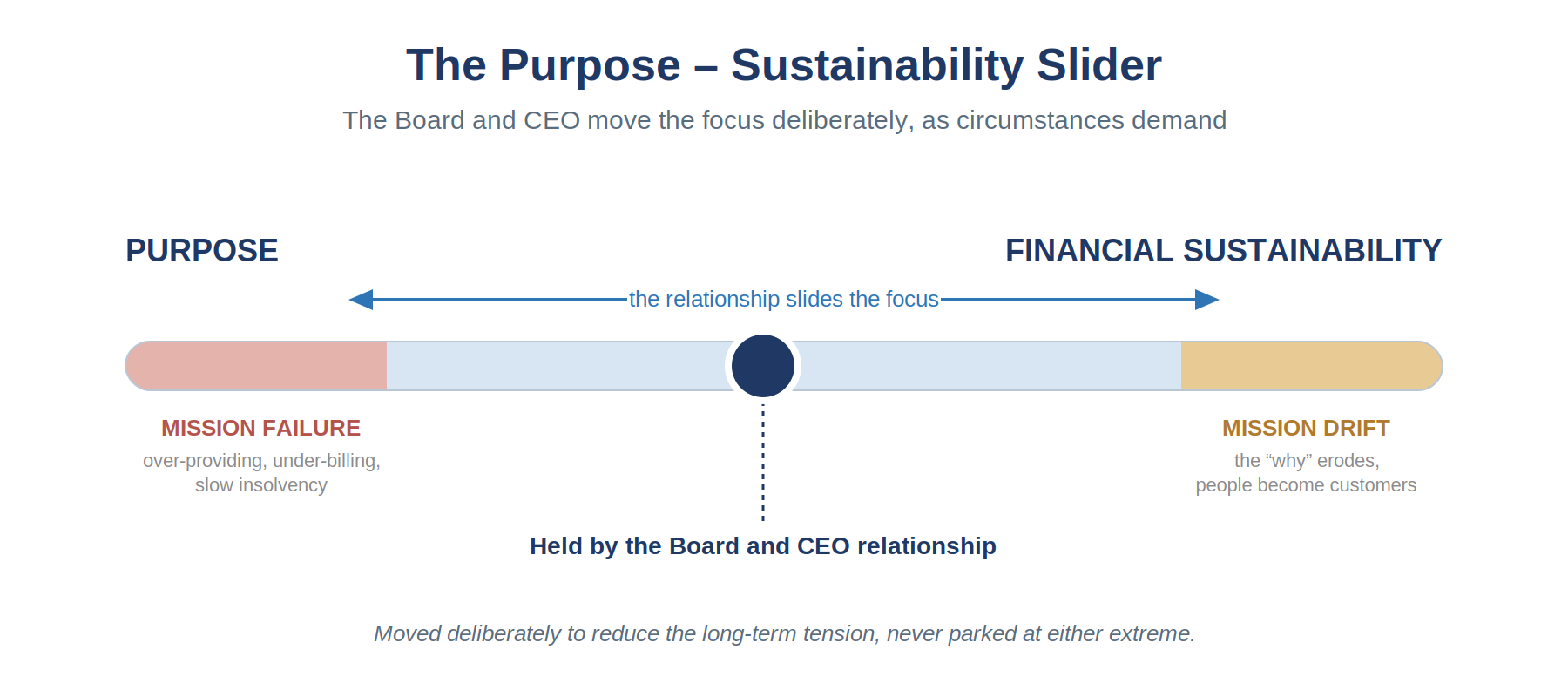
Consider the journey of a Western Australian provider. A few years ago, it was a legacy packaging business, dependent on NDIS funding and exposed to every pricing decision made in Canberra. It carried a second, quieter problem too. It was under-billing, or over-providing, depending on how you look at it, giving more support than it was funded for. On the surface that looked like mission in action. Underneath, it was steadily undermining the organisation’s future. The slider had drifted all the way to purpose, and no one had decided to move it there.
This is where the relationship earned its keep. Deciding, together, to stop under-billing was not a simple commercial fix. It meant a genuine culture shift, because many people in the organisation felt a duty to support regardless of the funding available, and it raised hard, sometimes unspoken questions about purpose. Left unmanaged, that is exactly the kind of silent disagreement that fractures an organisation. What prevented it was the machinery of the relationship: a shared design, an agreed framework, honest stakeholder communication, and disciplined implementation. The board and CEO moved the focus deliberately toward sustainability, explained why, and brought people with them. Today the organisation runs as a group of social enterprises, with roughly ninety-five per cent commercial revenue and only about five per cent from impact funding. The model changed because the relationship could carry the weight of changing it, and because it knew how to move the slider on purpose rather than let it drift.
A Victorian provider we know well shows the same discipline from a different angle. Transitioning toward a social enterprise model through a series of acquisitions, each one required to bring something of real value, what they have termed an acquisition dowry, it has grown only because a board and CEO in complete alignment are strong enough to say no to the wrong deal and yes to the right one.
How you know it is delivering
If the relationship is the delivery, then a board needs to know whether its own relationship with the CEO is working. The signals are consistent.
The vision stays shared: ask the Chair and the CEO where the organisation is heading and you hear one answer, in two voices. The tension is carried together, not handed over. In that same Western Australian organisation, the CEO told me they had identified the next acquisition, and the board was urging caution, reminding them not to overextend the management team, because the organisation still had to keep delivering for its clients and their families. That is not a board getting in the way. That is a board holding the non-negotiables alongside its CEO. It is also where the shift from oversight to foresight earns its keep: reporting that surfaces the trade-offs early lets the board hold the tension in real time, rather than discovering the strain too late.
And, crucially, the results feed back into the relationship. This is the part most people miss. A good early result, a new site opened, a contract won, an audit passed, does more than improve the numbers. It deposits trust into the relationship, and that trust funds the next, bolder move. Delivery compounds. The relationship and the results build each other, each success making the partnership more willing to take the next well-judged risk. The reverse is true as well: results used as weapons, by a board to blame or by a CEO to hide, drain the trust the whole thing runs on. In a delivering relationship, the numbers are read together, honestly, as shared information rather than ammunition.
Delivery costs something, and that is a boardroom conversation
None of this is cost-cutting dressed up. If anything, the opposite is true, and honest boards say so. Transition costs money. Whether you are transforming an existing business, acquiring others or starting new ones, there is a real cost to the change, and pretending otherwise is how transitions quietly fail. Modelling that cost, and deciding together how to fund it, is one of the most important conversations a board and CEO will have. It is the point where delivery stops being a slogan and becomes a shared financial decision.
That is why resourcing matters. You cannot deliver a transition on the strength of one exhausted CEO. Consider another provider, earlier in its journey, whose CEO told me how completely the work was consuming them, and admitted that if they did not personally sit in the transition meetings, business as usual would hijack the agenda and the change would lose focus. The board’s response was not to tell the CEO to try harder. It was to agree to bring in an additional executive for the transition, so the leader could give the change the attention it needed without letting everything else drop. A board that funds capability, backs external help and protects its CEO’s time understands that delivery is a shared undertaking, and an investment, not a cost.
The same logic runs through the team and the boardroom alike. The sector’s hardest people problem is real: you cannot pay what the commercial market pays. The new leader competes instead on what the sector can genuinely offer, purpose, real responsibility, role diversity, the chance to build something and to grow, and a culture people do not want to leave. A board serious about delivery makes sure its own skills matrix fits the task, with directors who bring commercial, financial and transition experience alongside deep purpose, so that governance keeps pace with the change.
The foundation beneath purpose
Return to the triangle. Purpose is the foundation, and strategy and culture rise from it. But the foundation itself rests on something, and in the organisations that are genuinely delivering, that something is the relationship between the Board and the CEO. Build and maintain that relationship well and everything above it has a chance. Neglect it and no strategy, however clever, and no culture, however warm, will hold under pressure.
Some will say this focus on the organisation and its leaders misses the point, that what matters is the person the purpose serves. They are right about the destination. This article has been about the vehicle: what holds an organisation and its leadership together well enough to get that person there.
This series began with an observation, formed across two recent conferences, that a new kind of leadership was emerging in the for-purpose sector. The first article brought that leader to life. The second revealed that their strength lives in the relationship between board and chief executive. This third one names what that relationship is for. It is not there to support delivery. It is the delivery, the patient, unglamorous, deeply human work of building the one thing capable of carrying an organisation through change without losing the people it exists for.
The leaders doing this well are not waiting to be rescued, and they are not doing it alone. They welcome external expertise. They are building the relationship and letting it build them. There is more to say about where that leads, and perhaps that is where this series goes next. For now, the measure holds steady, and it is the only one that ever mattered: is the person we serve better off? When the relationship is right, the answer, increasingly often, is yes.
Dr Myron Mann
Founding Partner, Innovation Impact Group Pty Ltd
July 2026